עבEN
The New Gallery · International Men's Day · 2026

Men, Masculinity and Fatherhood in a Changing World

Curators: Shai Pardo and Dr. Benjamin Bailey Professional advisor: Dr. Benjamin Bailey, Healthy Masculinity Center Bat-Yam Art Institute, named after sculptor Jacob Epstein, in collaboration with the Healthy Masculinity Center
Enter the exhibition
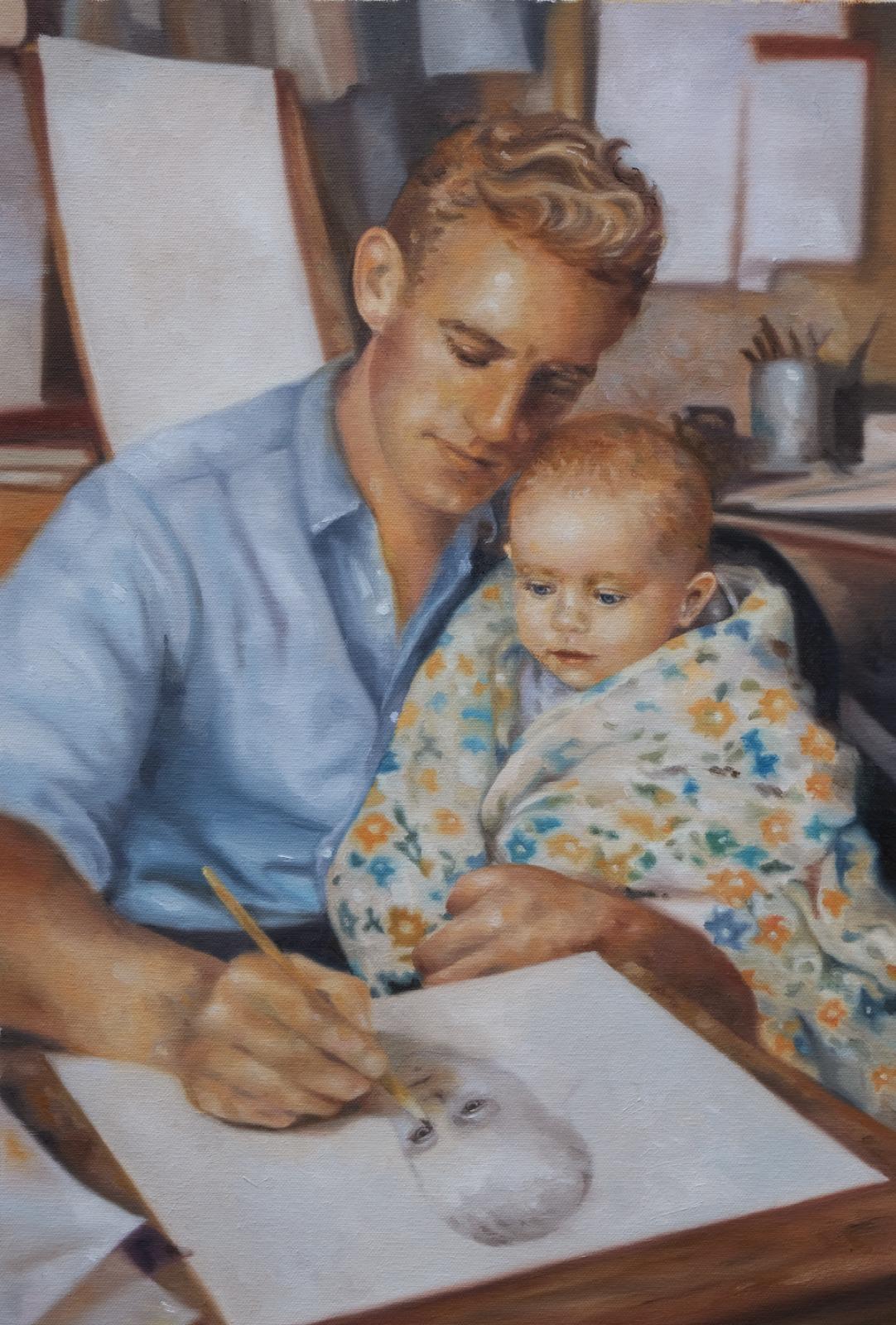
Painting of a young father holding his baby while drawing him
Raphael Salem, Untitled, oil on canvas

Curators' Words

Dr. Benjamin Bailey

Professional advisor and co-curator

In recent decades, significant changes have taken place in the status of women, in relations between the sexes and in traditional gender roles. Alongside these changes, we have grown used to a great deal of positive attention to the experiences and worlds of girls and women, while interest in what boys and men are going through is scant and tends to be critical.

The exhibition is presented to mark International Men's Day, observed every year on 19 November in more than 80 countries. The day seeks to highlight the positive contribution of men to their families and communities, and to raise awareness of the wellbeing of boys and men, of their dilemmas, and of the areas of life in which they struggle and are left behind.

The open call for the exhibition invited artists to look at the concepts of "masculinity" and "fatherhood" through their personal, family and social experience. As curators, we asked that their work address the meaning of masculinity in a changing world: what remains of the traditional expectations of men, what is changing, and which new ways of "being a man" are developing alongside them?

Six themes took shape from the selected works. They move from strength and vulnerability to the open and hidden tests through which masculinity gains recognition; through changing fatherhood and the relationships between fathers and their children, to men's work and the body that carries it; to the burden of expectations that men be strong, and finally to the warrior's wounds and the mental cost of moving between civilian life and the role of protector.

My hope is that the exhibition will open a way to look at the experiences of boys and men with a kind eye and an open heart, and will prompt conversations that usually remain unspoken.

Shai Pardo

Curator, the New Gallery, Bat-Yam Art Institute

The idea for this exhibition did not begin with a wish to define masculinity, but with an encounter with pain. In my everyday life I am often exposed to family disputes and to a complex legal and social reality that leads men into deep despair, and in some cases to suicide. This reality made me stop and ask how much we, as a society, see the distress of men; whether there is a language in which to talk about it; and where existing norms and institutions fail to respond to it.

As a curator, I decided to use art as a channel. Not to prove a claim, and not to give a single answer, but to let us look at, ask about and feel the man as a person, beyond the roles and expectations attached to him. The initiative also comes from my belief in the power of art, in a picture, a sculpture or a personal story, to advance a conversation in a way that direct speech does not always manage.

When I began looking for artists, it was important to me to include women and men: artists who are fathers and sons, mothers and daughters, partners. From these voices an exhibition emerged that looks at men through a range of perspectives and situations, and raises questions.

The exhibition will not resolve these questions, but I would like it to let us stay with them a little longer. For a more equal and healthier society, it seems we must be able to talk not only about what we ask men to change, but also about what happens to them within that change.

Participating Artists

Theme 1

Strength and Vulnerability

Almost universally and across cultures, raising boys into masculinity gives a central place to strength, independence, the ability to cope, and emotional restraint. These ideals are still present in the lives of boys and men, especially in traditional societies. Alongside them, forms of masculinity are spreading that make more room for tenderness, emotional conversation, and admitting difficulty, dependence and vulnerability.

The works in this theme live within that tension. They move from the male body that turns inward and averts its gaze, through the armour of the wounded knight, to the moment when the soldier's shell loosens and closeness and the need for another are revealed. Finally, the gaze turns inward, to the fatigue, the loneliness, and the conversation that takes place inside a man and is not always heard.

IdentityOil on canvas, 50×40 cm

Ella Barsky

The male body, turned away in the painting and averting its gaze from the viewer, appears here not only as a symbol of strength and power, but also as a space of inward withdrawal, sensitivity and perhaps vulnerability. The averted gaze suggests a retreat from the direct, decisive encounter that men are so often brought up to meet: to face difficulty, to cope and to project confidence.

The work widens the view of the male body beyond expectations of strength and control. A moment of rest and tenderness also becomes part of how the man is represented, through the body and its personal movement, and not only through the social roles expected of him.

The Wounded KnightCeramic sculpture, clay with matte and glossy glaze, 122×132 cm

Guy Jack (Yaakov) Meir

"The Wounded Knight" was made as a relationship was coming to an end, out of the pain and helplessness that came with a home falling apart. I found myself working on a piece that holds a slit-window mirror up to the idea of masculinity and to silenced injury.

The knight wears armour pierced and studded with nails and feathers: medals of honour alongside an invulnerability that has worn out. On his head is a cracked mask with small eye slits, and above it a broken, exposed helmet that reveals a small inner knight, with a garlic peel poking out of his head. Another layer is made of crystalline salt and paint; while making it, I felt as if the mask was "talking" to me, responding to my pain and weeping each time I brushed it.

In his rigid appearance, the knight takes apart the posturing and exposes the drama beneath the armour: the tension between the search for justice, strength and protection and the mental and physical price it can exact. The work let me give pain a form, to touch disintegration, loss and vulnerability, and gradually to heal.

With Their Backs to the WarAcrylic on canvas and photograph, 100×90 cm

Michal Litauer Gavrielov

A photograph from a series found in the family archive of my grandfather, Dr. Franz Litauer, who documented soldiers in the First World War. Rather than focusing on battle, heroism or national pathos, I chose to look at the intimate moments on the margins: bathing together in nature, rest between missions, and glances exchanged between men when vigilance slips for a moment. These are moments of closeness, embarrassment, humour and camaraderie, in which the military shell loosens and a vulnerable humanity is revealed.

On top of the archival photographs, printed on canvas, I intervene with acrylic paint. The bold patches of colour disrupt the nostalgic gaze. For me this is also an act of belated touch: an attempt to reach, across more than a hundred years, men who were required to embody strength, discipline and control, and to look for what escaped the official record.

I am drawn to the places where strength softens: not to the man as hero, but to the living, tired, vulnerable body that needs others. Despite the distance in time, some of society's expectations of men remain familiar. Today, too, men are required to show strength and restraint, while vulnerability, tenderness and dependence do not always get the same place. Through the meeting of the family archive and contemporary painting I want to ask: what is left of the man when the role peels away, and what is revealed when he no longer has to hold everything together?

Two Faces of MasculinityAcrylic on canvas, 50×70 cm

Anat Ben Ezra

What do we want from a man in today's society? Is strength measured by the ability to hide feelings, or by the courage to reveal them? Does tenderness weaken or empower?

The painting tells of fatigue and loneliness. For me, the blues in the background stand for quiet thought, depth and reflection. The man is not struggling outwardly but listening to the world within him. It is precisely when he stops fighting the image of firm, upright strength he is supposed to project, and allows himself to think, to feel and to be whole, that he discovers a different kind of power.

This is an inner journey between silence and presence. Behind every man there is a conversation that no one hears…

Theme 2

Masculinity Put to the Test

Behind the displays of resilience and strength, male identity is also marked by fragility and a need for outside recognition. More than girls and women, boys and men are preoccupied with whether they are seen as "man enough", not only in the eyes of women but also, and sometimes especially, in the eyes of other men.

The need for recognition also shows in the boundaries society draws between masculine and feminine, and in the social policing around them. The male body and male sexuality carry a similar charge: throughout history they have served as symbols of strength, potency and control, and have become part of how masculinity is measured and displayed.

The works in this theme examine these open and hidden tests: from the boundary between masculine and feminine, through the body and sexuality as markers of masculinity, to the need for approval and recognition from others. Finally, the gaze turns to the man himself, to the way he examines his identity, his strength and his responsibility within the society he lives in.

ShtreimelInkjet print, 64×43 cm

Yehuda Ofman

The image "Shtreimel" is part of a series of self-portraits in which I explore the tension between identity, tradition and self-definition. In a space of inner freedom, moving between who I was and who I am today, I play with elements of traditional, devout Haredi dress and offer them new, free and queer interpretations.

Within the religious context, the questions sharpen around the boundaries of the permitted and the forbidden regarding the body and actions associated with masculinity, such as laying tefillin and wearing tzitzit.

In the space that opens up, I take apart and rebuild signs, clothing and identity, and connect worlds that are not necessarily separate. Past and present exist in the same body, and identity becomes a space of searching, movement and becoming. The work does not seek to decide between the possibilities, but to stay within the tension, to hold the complexity, and to let things that seem contradictory exist together.

UntitledGarage scrap, 45×45 cm

Haim Ohayon

The basis of the sculpture is male sexuality. The state of arousal it depicts is an image identified with masculinity, strength and potency, but the choice to build it from pieces of chain and exposed welds seeks to widen the view of masculinity beyond that image.

For me, the chains and welds stand for the fact that a man is not defined by one thing. Masculinity can be strength and toughness on one hand, and vulnerability, scars and pieces of life joined together on the other. The joints and scars are not hidden; they become part of the body and of the story it carries.

Rav-On (Potent)Iron wire, 180×170 cm

David IsaacsIn collaboration with Ella Rosenberg

Since the beginning of the war I have drawn about 250 gay men. From these encounters I made an iron-wire drawing that tries to touch the inner, emotional and sexual world I met in them. Outwardly, many of them seemed restrained, with a strong need for self-control; once they undressed, a different world opened before me, of desire, vulnerability, poor body image and preoccupation with penis size.

But more than anything, I sensed loneliness in these men. Again and again I met men who wanted a place to unload their personal world and to receive intimate approval of who they are, without judgment.

Perhaps this is my way, through humour and pain, of speaking about the male need for approval, about the gap between the standards by which a man is supposed to be measured and his human reality. And out of these encounters I found myself thinking: men are the ones who run the world.

Close to Me, Far from MyselfMixed media, 32×180 / 20×20×180 cm

Sergio Daniel Chertkoff

Every day, for as long as I have been aware of myself, has been Men's Day.

Every day, always, the patriarchal mechanism has been responsible for killing, destruction and murder. As a painter and as a man, I choose on this day not to celebrate masculinity but to look at it critically, to look in the mirror and examine myself, my role and my place in relation to women and to society.

In this exhibition I show oil paintings on canvas that dismantle the male gaze and place it between historical guilt, personal vulnerability and moral responsibility. The self-portrait, made of three vertical panels, offers an alienated, fragmented inward look. The painting moves along an axis from realistic focus to pixelated abstraction; the further the viewer moves from the eyes, the centre of gaze and consciousness, the more masculinity loses its coherence and scatters into disconnected squares of information.

Beside the portrait are 32 small canvases bearing emoji images that I have used personally. This sequence translates everyday emotional life into a flattened, levelled digital language that frames and reduces human experience to predetermined symbolic templates.

Theme 3

Fatherhood

The figure of the father has changed considerably over the generations. From a father identified mainly with authority, providing and protection, there has been a growing expectation and norm, for several decades now, of a more present and involved fatherhood: one that, alongside security and stability, also holds tenderness, emotional closeness, partnership and involvement in children's everyday lives.

Alongside this social change, the bond with the father is one of the most formative relationships in children's lives. The father's figure and the relationship with him are internalised and leave a mark, more or less benign, far beyond the years of childhood. They accompany us into adulthood, shape how we see ourselves and our relationships with others, and continue to live within us even after the father is no longer alive.

The works in this theme look at fatherhood across the life cycle: from the father caring for his baby, through the bond between a father and his adolescent and adult children, to the memory a father leaves after his death. They deal with closeness and identification, with the legacy passed from fathers to sons and daughters, but also with weakness, mistakes and sorrow, and with the ways the bond with the father goes on living within us.

UntitledOil on canvas, 38×57 cm

Raphael Salem

The work depicts a quiet, intimate moment in which a father holds his baby and, at the same time, draws him. The act of drawing connects fatherhood and creation and lets both exist together in the same moment.

For me, the image also comes from my own experience of fatherhood, raising twins, and from the daily struggle to find a balance between paternal responsibility and presence at home and the work and need to keep creating. The father in the painting is not shown as an authority figure or a hero, but as a person who is present, caring and vulnerable, who seeks to preserve, within family life, his identity as a creative person.

A Sign for the Sons #1Oil on wood, 47×27 cm
A Sign for the Sons #2Oil on wood, 47×27 cm

Tali Gal

These works are part of a personal series following my son's growing up and his relationship with his father. From a documenting, maternal point of view, I look at how a young male identity is shaped in relation to the father figure: a bond that takes on new weight and sensitivity with my son's recent enlistment in the IDF, at an elusive point in time between holding on and letting go.

Although the home we built is one of equal parenting, with a father who is present, sensitive, attentive and nurturing, we discovered that it still holds a division into roles perceived as gendered. In the paintings I look at these moments of closeness and intimacy, and at the almost unconscious passing of "masculine" patterns from father to son.

This process meets my son as he is busy building his macho image and aspiring to a combat role in his military service. Alongside justified pride in him, I carry the worry that the outer shell will blur who he really is. Through the work I want the world to see that beneath the armour, the image and the uniform is a sensitive, deep and thoughtful person, whose identity is not summed up by the social expectation to be a "real man".

Abush (Dad)Oil on canvas, 90×70 cm

Shoval Elbela Geva

I began working on the painting after our preliminary meeting, which dealt with how masculinity is perceived in society. I came out of it thinking about patriarchy and machismo, along with the problems and hardships of men that came up in the conversation. And amid all this, the first real man who came to mind was my father.

I breathed a deep sigh of relief. How lucky I am to have a father who truly sees me!

A father who is not bound by the old "rules" of his generation. I am so proud to share his painting, because to me he is the true symbol of masculinity: a successful, wise, funny man, and above all a wonderful father!

LegacyEmbroidery on a vintage napkin, 33×33 cm
Maybe in the Next LifeEmbroidery on a vintage napkin, 33×33 cm

Tamar Zolberg

My embroideries are made on old fabrics, handkerchiefs, napkins and scraps: materials that come from home, from memory and from the intimate. I embroider figures, words and feelings, giving form and voice to my positions on what surrounds me and us. The works shown here deal with men, but through a woman's eyes.

"Legacy" is a combined portrait of a woman and a man, embroidered on an old handkerchief. Her face peeks out from his, and the other way round. Because that is how it is: we are daughters of fathers who are inside us. They are there in the way we look at men in adulthood, and in the masculine parts within us.

In "Maybe in the Next Life" two figures stand facing each other, with a red thread between them. She is densely embroidered; he is outlined only, like a draft. The text reads: "Maybe in the next life I'll see the world like a man, but now I see like a woman." It is a work about what we women do not see, and what they do not see.

Together, the works ask: what do we take from the men who raised us? What do we look for in the men we choose? And where, in all of this, is there a little of them in us?

My Father Returns from the Suez CanalGlass and nails, 33×14 cm

Ran Shayit

For me, working in glass is a kind of extreme pursuit. Glass is hard yet very fragile, transparent and at the same time reflecting light and image. It is unforgiving: a slight irregularity is enough to crack it, and it does not always yield to the artist's will. And yet, when the kiln door opens and the beauty that has formed is revealed, I feel I have managed to tame it.

When my father died, I was left with hard memories of his illness and helplessness in his final years. At first I preferred to remember him as he had been: healthy, sturdy, active, energetic and wonderfully resourceful. But his figure in those last years, weak, lost and touching death, would not let go of me. In those years hard memories from his life also resurfaced: his childhood lost in the Holocaust, his fighting in three of Israel's wars, his severe wounding in the last of them, and the loss of a young son in another war. All of this pushed me to sculpt him in a morbid, dark image.

Parenthood is a challenge we do not arrive at prepared. It is a process of learning on the move, and especially with a first child, mistakes are made, some of them beyond forgiveness. From those mistakes a taut strip of sorrow remains in a father's body.

Theme 4

Men's Work

Much of the physical world that serves our everyday lives is built and maintained by men. On construction sites, in agriculture, industry, infrastructure maintenance and transport, many men do hard physical work every day, sometimes in extreme weather and at risk of injury and even death. This work is essential, yet those who do it often remain anonymous and almost invisible.

The discourse about power and privilege in men's lives does not always leave room for another side of their lives: the physical labour, the wear and the risk, and the daily contribution of many men to the ongoing life around us.

The works in this theme turn the gaze to the working man and to the body that carries the work: to the effort, the wear and the risk, but also to the responsibility, creativity and meaning that come with doing. They invite us to look at the people behind the work, the men who build, grow, manufacture and maintain much of the physical world around us.

Rake ManMixed media, 157×155×65 cm

Nov Har Zion

In the first decades of the state, on kibbutzim and moshavim, strenuous physical labour was a central part of the image of the male farmer. The sculpture looks at the physical cost of agricultural work and the devotion it demands.

Physical, Sisyphean labour leaves its mark on the body. The extremely thin figure of the rake man expresses exhaustion and wear, but also the deep bond between a person and his work. Through the working body, the sculpture also seeks to draw attention to the fragile state of agriculture and to the people who go on carrying it in their bodies.

Ahad Ha'amEngraving on plastic-coated plywood, diameter 70 cm

Rona Shachar

I painted the building that was going up on my street because the noise was driving me mad, and I decided to try to turn reality into art. As I followed the building's progress, my gaze moved from the structure to the people building it: to the workers and the physical, gruelling and sometimes dangerous work they do.

During the construction, to my relief, not a single worker was hurt. I felt that the fact that I was painting them, following them and giving them my full attention was somehow signalling to the universe to protect "my" workers.

Construction work in Israel also carries a complex history and social reality. The workers in the painting carry on their backs not only the effort and risk of physical labour, but also the weight of the Israeli-Palestinian conflict. There are further layers in the work, but I prefer to leave the viewer room to see and think for themselves.

Movers Ltd.Watercolour, 38×48 cm
The Chinese WorkerWatercolour, 34×25 cm

Mati Lahat

In a series of watercolours I documented the "evacuate-and-rebuild" urban renewal process I went through, carried out by men from worlds near and far. First came a crew of men who one morning turned our life into a heap of boxes and furniture: Movers Ltd. After them came another crew of men, who took apart and demolished an entire neighbourhood down to its foundations, to put up in its place a huge 35-storey housing machine.

I watched these men working, dismantling, moving, demolishing and building, and the roles they fill in a process that completely changes our living environment. Each of us acts and is acted upon at different moments of life within some role, by choice or by force of the reality of being a man.

Theme 5

The Burden of Expectations

The expectation that men be strong, responsible, protective, providers, and able to withstand hardship is not necessarily only a burden. For many men it is also a source of meaning, pride, self-worth and belonging. The willingness to bear responsibility, protect others and keep functioning in difficult conditions is a deep part of how many men understand their place in the family and in society.

But the high bar of expectations of men also has a price. The familiar cultural message of "Man Up" (be strong, get over it, don't complain, manage) can become harsh and uncompassionate when it leaves no room for a man who cannot, does not want to, is tired, afraid, or himself in need of support. The demand to keep holding on, leading and protecting can become a burden when the option of setting it down, even for a moment, is not seen as legitimate.

The works in this theme look at this burden and at how it passes between generations and takes different forms. They deal with strength, responsibility and sacrifice, but also with the price of having to be the one who holds others up over time. They turn the gaze to what lies behind the image of the strong, steady man: the loneliness, the fear, the vulnerability and the cracks that are not always given room to be seen.

His PresencePhotography and fine art print, framed behind museum glass, 70×50 cm

Dina Shamir

The father is shaped as an archetypal figure, a kind of epic hero, leaning on a half-uprooted pine tree in a dramatic rocky landscape. He embodies the traditional father: an existential rock, a protective wall, the one required to project strength, stability and uncompromising presence.

But within this image of strength the cracks appear too. The twisted tree and the heavy shadows reveal the other side of the archetype: the rigidity, the loneliness and the price of having to keep holding on to the hero's mask. For me, the wild nature surrounding the father expresses the tension between strength and vulnerability, between the wish to control and protect and the forces threatening from outside and within.

A mixed-media collage combining a 1916 landscape photograph by Ansel Adams with a family album (made at "HaMerhav for Photography and Art", guided by Sagit Zaluf Namir).

Intergenerational TransmissionProcessed photograph, hand collage, fine art print, Dibond, 50×70 cm

Dalia Ben NunMade at "HaMerhav for Photography and Art"

Male upbringing does not begin in a vacuum. Values of volunteering, sacrifice, resilience and readiness to be strong for others pass from fathers to sons, and can give a sense of belonging, meaning and recognition. But alongside them another message may be passed on: don't cry, don't show fear, play down pain and vulnerability.

My father fought in the War of Independence. His figure in this work is taken from a private photograph from a family archive. It was taken at a happy time in his life, on an outing to the beach with his friends. The gap between the light, happy moment in the photograph and what I know of his life and the price he carried lies at the heart of the work.

While making it I thought about the question: what do we receive from the generations before us, and what do we, sometimes without meaning to, pass on?

UntitledColoured pencils on partially raised cardboard, 25×35 cm

Sigal Yaar

The work was made during the struggle over the changes to Israel's judicial system, out of a feeling that something fundamental was about to crack. At its centre is a father carrying his daughter on his shoulders, an Israeli flag in his hand and cracked ground beneath his feet, almost as after an earthquake.

My connection to the subject of masculinity lies in the father as someone required to remain an anchor even when the ground beneath him is unstable. He carries his daughter physically, but also the responsibility for her safety and her future: an expression of the traditional view of the man as protector, leader and "rock" of the family. Except that here the rock itself stands on shaky ground. The flag adds a collective layer: the father carries not only his daughter but also the country she belongs to.

The girl on his shoulders is also the next generation: she is above him and sees ahead, while he is the one carrying her. The work does not present the man as an all-powerful hero, but as a person required to hold others up even when he himself is not standing on safe ground. The gap between the expectation that he be strong and steady and his vulnerability and uncertainty is where I meet the idea of masculinity today.

Theme 6

The Warrior's Wounds

In the Israeli reality, the traditional role of the man as protector takes on a very concrete meaning. For more than three years of war, tens of thousands of men have repeatedly left their homes, their partners and their children, and have had to move within hours from civilian life into a world where vigilance, strength, mastery of fear and readiness to use violence are conditions for their survival and for protecting others.

Society needs fighters who are able to do this. But the psyche does not necessarily move between these worlds at the same speed. Behind the weapon and the uniform is the same person who needs closeness, tenderness and security; a partner and father who must sometimes push these parts of himself away in order to function as a fighter, and then come home and find his way back to them. The war does not necessarily end for him the moment he puts down his weapon.

The works in this theme turn the gaze to the tension between the warrior and the person beneath the role: between strength and vulnerability, between vigilance and closeness, between readiness to use violence in order to protect and the ability to return to touch, family and everyday life. They also deal with what remains afterwards: memory, pain, and patterns of power and violence passed between men and between generations.

Upon the Face of the WatersPigment print (Giclée) on Hahnemühle paper, 60×60 cm

Yehoshua Yosef

"And the spirit of God moved upon the face of the waters"

The work responds to the verses of Creation in the Book of Genesis. At the centre of the image a man and a woman stand in water, in primeval nature, almost completely exposed. They look like a contemporary Adam and Eve, but beside the man appears one detail that breaks the archetypal calm of the picture: the rifle.

The man and the woman stand side by side, equally exposed. The man is not shown as a soldier on the battlefield but as a vulnerable person, and the weapon in his hand becomes the only sign of his role as fighter and protector.

The meeting of the bare body, the water, nature and the weapon creates a tension between a primeval world of Adam and Eve and contemporary Israeli reality; between the man required to protect, hold out and bear responsibility, and the exposed, vulnerable human body beneath the role.

Your Place Is HereEmbroidered on a linen table napkin dyed with Atlantic pistachio gall, 34×50 cm

Yael Pulvermacher

On 7 October 2023 our son woke up in one of the moshavim of the Besor region, where he was staying with his girlfriend's family. After about 48 hours, when they were able to leave, they came to our home in Jerusalem. We first of all sat and listened to them. The next day he was already called up for reserve duty.

One of the stories he told seemed undramatic, but it gripped me hard and has stayed with me ever since. When the family was allowed to get ready to evacuate, our son stayed at the doorway of the house with a knife, keeping guard. At one moment his girlfriend walked past him, put her hand on him and stroked his back. He shook her off and told her it was impossible: he could not, at the same time, be in the state of mind that if someone came he would have to kill first to protect them, and also be caressed and caress.

I think a lot about what we lose when we send men to fight and demand that they move in an instant from closeness and tenderness to vigilance, protection and readiness to kill, and then come back from all that.

We lose the fluids of life.

Give Me a Minute to Get Used to You AgainOil on canvas, 60×50 cm

Talia Brenner

The painting shows little Uri welcoming her father, who has come back to her from reserve duty at the beginning of 2024. She wants to be with him, play with him, make him pretty. So much time has passed. He too wants to be with her, holding and held, and yet his gaze stays sunken, stuck somewhere else. He gives himself to her, but it seems he is still not fully present, not really back yet.

I chose to paint in a cold blue, which on one hand gives the scene a dreamlike feeling and on the other emphasises the estrangement forced between father and daughter. The red of the nail polish recalls blood: a hint of the memories and thoughts that may accompany the father-soldier even in this intimate moment.

The price of war is terrible. Everything must be done so that fathers are not forced to leave home suddenly and vanish into blood, sweat and tears. When I think of the phrase "father-soldier", it seems to me a terrible distortion, a terrible contradiction, a terrible injustice.

Brothers VIDEOVideo dance

Tal Gur

The work is based on Dan Pagis's poem "Brothers", which responds to the story of Cain and Abel, and looks at masculinity through the moment when a bond between men turns into a struggle for recognition, power and love. Cain kills his brother, but Abel does not disappear from his life: the act and the lost brother go on accompanying him. The tragedy also lies in the fact that beneath the jealousy and the violence there was a need for closeness.

In the work I also return to the figure of the father. In the biblical story Adam, the biological father, is barely present, while God appears as a father and authority figure. It is precisely His presence that ignites the jealousy between the brothers, and after the murder Cain is left to bear the consequences of his deed in a world without that providence.

Through original music, dance and video, the work deals with the inheritance men receive from their fathers and from earlier generations in patterns of power, competition, jealousy and violence, but also in the longing for closeness, brotherhood and recognition. The question for me is what we do with the inheritance we received: what of it we keep carrying, and what we can choose to change.

Epilogue

Male Confusion

The exhibition opened with the question of what it means to "be a man" in a changing world. It ends without a single answer. Alongside the long-standing expectations of men, other expectations have gained more ground in recent decades: to be egalitarian and sensitive, attentive partners, present fathers, in touch with their feelings and able to express vulnerability.

The change under way opens new and important possibilities for men, but it also often creates tension between old and new expectations, which do not always sit well together. The poem "A Confused Man in a Crazy World" by Dana Finblat Edri looks at this tension with a smiling but clear-eyed gaze, through a man trying to find his place between strength and tenderness, independence and closeness, providing and fathering, freedom and commitment.

The chart "Hybrid Masculinity" offers another view of the same tension: there is no need to choose between the options, but rather to learn to move between them and give room to different parts of masculinity according to the situation, the relationship and the circumstances.

Dana Finblat Edri

A Confused Man in a Crazy World (translated from the Hebrew)

A confused manin a crazy world,doesn't know what's expected of him,when to insist and when he'd better let go.

It's hinted he should show principles of equality,but also keep on hunting and bringing home plenty of money.His hormones are tuned to guard the family,and sometimes to sprawl on the sofa and let out a sigh.

Lately they've started asking him to look in the mirror,to check if his haircut and jeans are in line with the times,and if hairs adorn his back and the strip above his behind –maybe he'll pluck one or two, here and here and here.

And of course, he mustn't forget the wedding anniversary or Valentine's Day,last year she accused him that the candle between them had nearly gone out.At parents' evenings he'd better show up, and know where the classroom is,not to mention being the perfect lover in bed.

And since his wife runs the house,it sometimes seems she rules him too,and then he turns into a people-pleaser –and a people-pleasing man, who wants one at all?

And then he's confused, wants a little quiet, enough,saying "yes" looks to him like a default.Sometimes he wants to change course,he feels caged, like a rooster in a coop.

Sometimes a heaviness falls on him,the thought of leaving floods him with loneliness.To start everything from the beginning?That's a very big task.

The need for freedomclashes with the warm home –sometimes taken for irresponsibility,or maybe simply, an identity crisis.

Sometimes all he needs is a stroke, a hug,to know someone is there behind him when he's in need.To know that he is relied on.And yes,he too would be glad to get, on a Friday,every now and then, a bouquet of flowers.

Hybrid MasculinityChart, 29×42 cm

Benjamin Bailey

QR code for the Healthy Masculinity Center website Healthy Masculinity Centerהמרכז לגבריות בריאה

The concept of hybrid masculinity, which emerged from contemporary theoretical discourse on masculinity, describes a combination of elements identified with traditional masculinity and elements identified with new masculinity. The chart shown here is my own development of this idea.

The traits in the two circles do not necessarily contradict or cancel each other out, since male identity is not uniform and rigid but flexible, changing according to circumstances and context. For example, traits identified with traditional masculinity, such as a willingness to take risks or the ability to suppress emotions when acting under pressure, have value and can be a needed resource in many situations in the lives of couples, families and communities. But when these traits become a rigid demand, of a person on himself or of those around him, that leaves no room for vulnerability, dependence or the need for support, a problem arises. There are also moments when the combination itself may not be possible, as the questions in the orange boxes suggest.

In my view, there is no man's life that does not move along the axis between the "strong" man and the "sensitive" one, whether consciously or not. More and more men seem to combine independence, responsibility and strength with emotional connection, tenderness and intimate skills. This is a process that challenges us men to develop psychologically; and although by its nature it can be confusing, in my eyes it is encouraging and welcome.

In Closing

The exhibition "Men, Masculinity and Fatherhood in a Changing World" set out to shed light on some of the dilemmas in men's lives at a time when relations between women and men are changing rapidly. Clearly, in a reality where equality between the sexes is seen as a worthy value and an accepted norm, and women's independence keeps growing, the status, roles and world of men cannot remain as they were.

As several of the works show, the changes in men's lives and in society's expectations of them do not concern men alone. Women, no less than men, need to clarify which of the old and new expectations they bring into their relationships with men. These questions, in different forms, meet couples and families across Israeli society and its many communities.

Alongside the investment and interest in advancing the status of girls and women in recent decades, attention to what boys and men are going through in this period of change has largely stayed on the margins. This exhibition seeks to help widen the view and the conversation to include them as well. What is the place of men within changing relationships between the sexes, and what does a masculinity look like that is good for both men and women in a more equal world? These are important questions that remain open and call for more personal and public attention.

We hope the exhibition will stay with you after you leave it and stir thoughts about the issues it has touched. Interest in the wellbeing and lives of boys and men concerns the future of society as a whole, which is also made up of the fathers, partners, sons, brothers and nephews of us all.

Opening hoursSun 19:00–20:00
Tue 11:00–14:00
Thu 11:00–12:00
Address18 Simcha Holtzberg St., Bat Yam
To arrange a visitTzvia: 054-8095520
The Institute: 03-5064237
Exhibition closes26.12.2026
Please confirm before you come that a visit is possible on that day.
Partners: Bat-Yam Art Institute, Bat Yam Municipality, the New Gallery, Bat Yam Painters and Sculptors Association, Bat Yam Culture, Leisure and Sports Company, Healthy Masculinity Center